
What is AIoT?
Artificial Intelligence of Things (AIoT) refers to the integration of IoT devices with artificial intelligence (AI), adding a layer of knowledge processing to the data communicated from IoT systems. This convergence of technologies is enabling us to move past not only collecting and communicating data, but also interpreting it to detect patterns, predict outcomes and automate processes (Rohaninejad & Nozari). Where IoT connects assets, AIoT makes them intelligent. In the context of the supply chain, AIoT is not only connecting thousands of assets, such as containers, ships and ports, but actively optimising how they move through the supply chain at scale.
AIoT Industry Size
The number of active IoT (Internet of Things) devices globally has been growing steadily over the past number of years, with more than 40 billion forecasted to be in circulation by 2034, according to the Global IoT Forecast Report (Transforma Insights). With this volume of sensors reporting on a host of data points, efficient AI analytics becomes crucial to unlocking valuable, actionable insights that drive better decision-making. Many of these devices are deployed for the role of remote asset monitoring in the supply chain, making it crucial for those in the industry to understand the implications of AIoT. For example, the real-time monitoring of temperature-sensitive, cold chain goods. In this article, we will explore everything you need to know about AIoT and its applications for the supply chain.
Cloud-Based versus Edge-Based AIoT
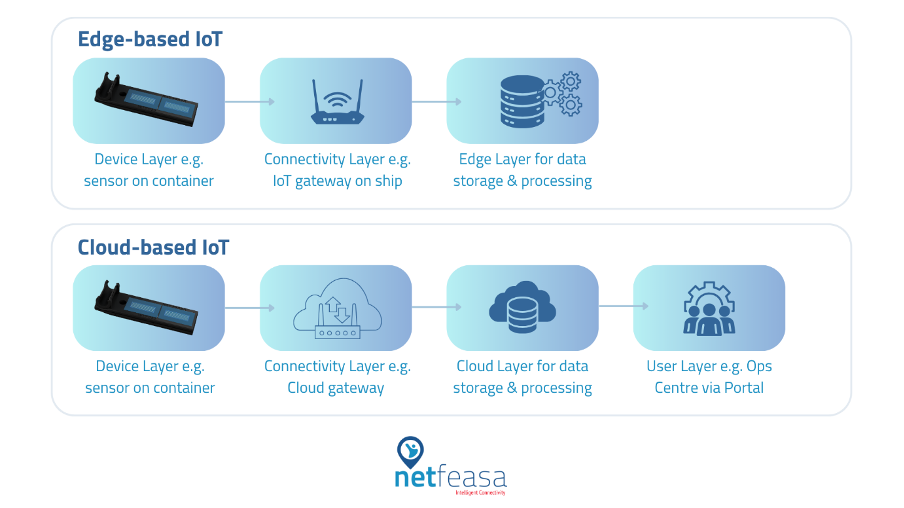
There are two distinct set ups for AIoT as it pertains to the supply chain; Cloud-based and Edge-based. They are often combined and used for different purposes in supply chain operations.
Edge-based means processing the data as close to the device as possible to move data quickly. This is useful for enabling quick responses to time-sensitive alerts relating to potential cargo safety or security risks e.g. an open container door, or Dangerous Goods heating up.
Cloud-based allows for processing, management and storage of the data, making it a good option for more strategic, less urgent activities, such as analysing trends at the fleet level. E.g. predictive maintenance to a reefer container (TechTarget).
AI Technologies Used in Supply Chain AIoT
-
Machine Learning (ML): Systems improving over time by learning from their own performance. On-device ML is gaining traction as AI models become more lightweight and energy efficient, which improves the performance of container and other sensors over time e.g. for energy optimisation (Viso.ai).
-
Agentic AI: A newer class of AI which can make decisions and execute tasks with minimal intervention needed. This is a major breakthrough for automating the largely manual logistics operations of the supply chain, but is still in the early stages of reaching the market (Read more here).
The Benefits of AIoT for the Supply Chain
AIoT can help supply chain operators to remain resilient and dynamic in the face of unprecedented times of disruption and uncertainty. The following examples demonstrate some of the many benefits and use cases of AIoT in the supply chain:
- Risk Reduction: The supply chain faces a diverse range of risks which are costly to manage. For example, vessel fires, which are at a decade high (Allianz), can cost several millions of dollars (Maritime Cyprus). Net Feasa's IoTPASS™ smart container device has a built-in heat sensor for detecting potential temperature anomalies earlier in dry cargo.
- Cost Reduction: Industry estimates for telemetry penetration levels in reefers (refrigerated containers) are at approximately 50% of the global fleet (Drewry). Net Feasa's Agentic Control Tower™ Port Agent helps Terminal Operators to cut reefer monitoring costs through real-time visibility of these containers, so that only a fraction of the reefer area needs to be manually inspected.
- Efficiency Gains: During a voyage, crew members on a cargo ship must conduct walk arounds as often as every 6 hours to physically check the condition of up to 1000 reefers onboard (West of England P&I). Net Feasa's Agentic Control Tower™ Vessel Agent is vendor agnostic, allowing the crew to monitor all smart reefer makes & models from the vessel bridge in real time and drastically reducing inspection times.
Frequently Asked Questions
What is the difference between AIoT and IoT?
IoT (Internet of Things) refers to connected devices that collect and transmit data. AIoT adds a layer of intelligence to this data, enabling patterns to be identified for predictive outcomes, i.e. context-aware insights over raw sensor readings. E.g. An IoT container sensor can transmit temperature readings for fire safety. An AIoT sensor can take into account environmental factors & patterns that might impact temperature readings to more accurately detect anomalies.
How is AIoT used in container shipping?
In container shipping, AIoT devices monitor assets in real time, such as reefers (refrigerated containers) and dry doxes. Asset owners can not only track their asset location, but also conditional factors like temperature and door events.
What risks does AIoT reduce for the maritime industry?
AIoT reduces risks such as vessel fires, cargo spoilage & loss, cargo theft and smuggling through continuous visibility and real-time alerts. It also improves overall risk management by providing time-stamped evidence of alarms and crew responses for reducing claims and disputes.
What is edge computing and how does it relate to the supply chain?
Edge computing means processing data on or close to the device e.g. container sensors like IoTPASS™, rather than sending all raw data to the Cloud for analysing. This reduces latency and enables real-time alerts in low-connectivity environments.
Note: AIoT deployments in maritime logistics typically require reliable connectivity infrastructure, hardware integration work, and cross-team coordination. ROI timelines vary by fleet size, asset type, and operational context — pilots with a subset of assets are common practice before fleet-wide rollout.
Got a question about AIoT for the supply chain? Get in touch to learn more.
About Net Feasa Ltd.
Net Feasa is a trusted AIoT service provider to the global maritime supply chain, enabling safer, more efficient operations through digital transformation. Our early IoT experience has allowed us to build and refine an AI-based wireless platform which orchestrates the flow of context aware and actionable data, directly from the sensor to The Cloud. We deploy real-time visibility and connectivity for shipping lines and terminal operators to better protect the cargo that they help to move around the globe.
This article is written by Dale Breheny, Sales & Marketing Manager at Net Feasa, with 2+ years expertise in Maritime IoT.
First Published: 24 July 2025, Last Updated: 09 June 2026.